Messing about in boats since 1975. Online Since 1997.
Home | Intro | Our Design Process | Stock Design Info | Motor Yacht Designs | Sailing Yacht Designs | Prototype Designs
Plans List | Articles | Our CAD Design Stream | Maxsurf | SITE MAP..! | Site Search | Design Team | Contact Us
Please see the AVAILABLE BOAT PLANS web page
51' to 70' Skipjack
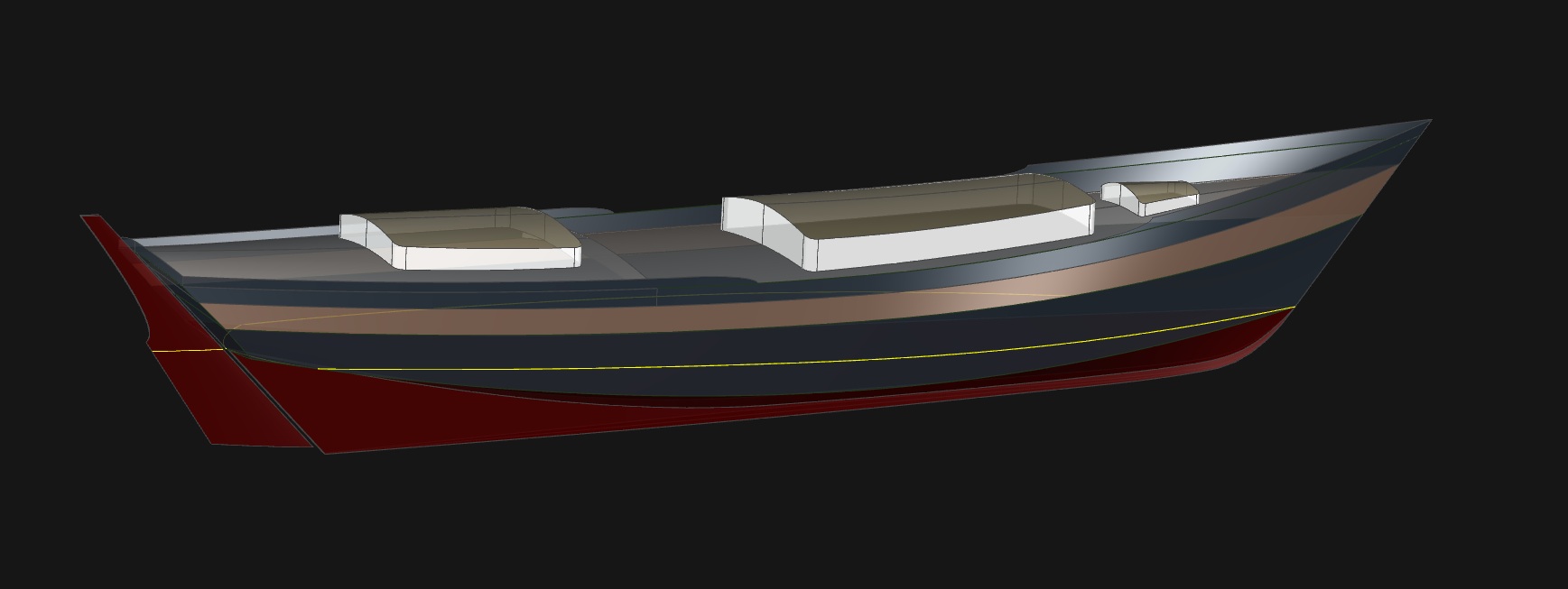
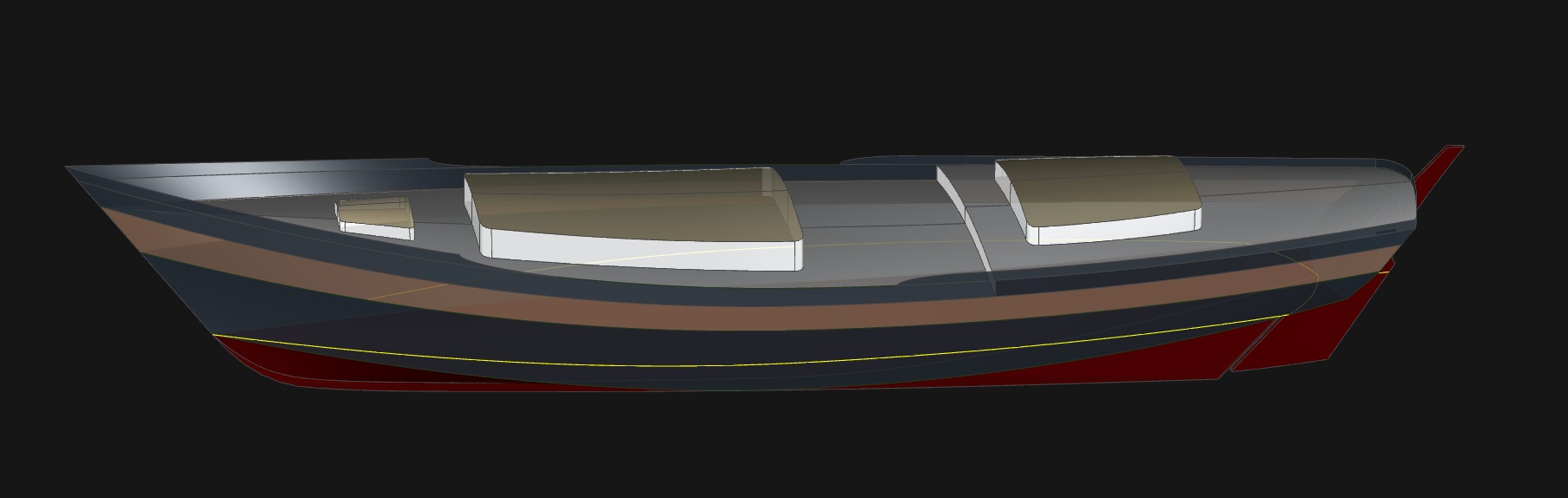
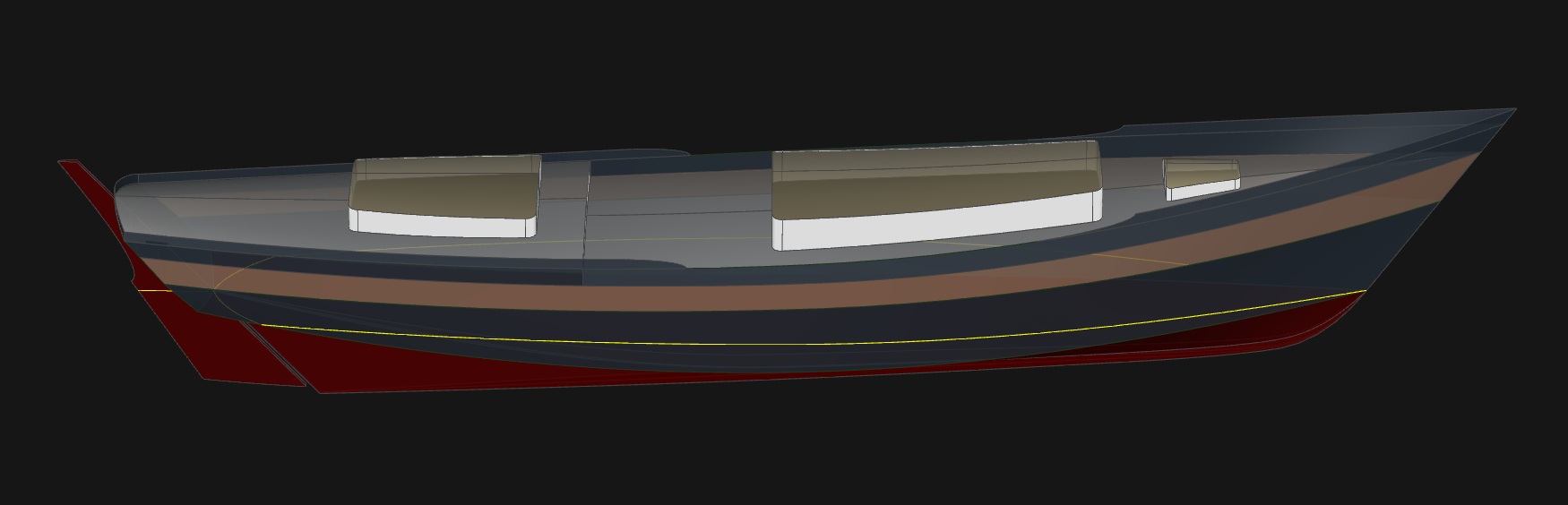
Larger Stb'd Aft View | Larger Portside Fwd View | Larger Side ViewCopyright 2001 - 2011 Michael Kasten
General Concept
Dockside wags may well ask, "Why did you bother fooling around with a dowdy old-fashioned sailing type, and one that was not even intended for open ocean sailing...?"
- First: I wanted to start with a traditional type that could be easily built in steel or aluminum or any other flat sheet material, thus having a single chine hull shape for ease of construction. The Skipjack is perhaps the ultimate in terms of being an aesthetically refined traditional sailing vessel which has always had a single chine hull shape. No one argues with the shape, since these vessels have never been otherwise.
- Second: I was told in no uncertain terms by another Naval Architect that a Skipjack would never be safe as a yacht, nevermind a yacht that is intended to venture offshore... Well of course with the original flat, shoal-body, wide, low-freeboard Skipjack form - I agree totally! But never say never..!
Naturally, I took exception to the claim that the Skipjack type could not be adapted to being a safe and seaworthy yacht... One that could sail in the open ocean, but still preserve the aesthetic character and general shape of the original Skipjack types. Thus, more or less as the result of the implied 'bet' that I could not, I developed the 50' to 70' Skipjack design series illustrated here...!
My goal in doing so was to create a classic sailing yacht that could travel the oceans of the world; that preserved the original character of the Skipjack type; and that could be simply and economically built in steel, aluminum, or other flat sheet material. Illustrated here is a 70' version of the resulting Skipjack prototype.
As a further extension of this hull design type, I have also developed a larger version that can be seen on the 100' Bermuda page, as well as on the 100' Cargo Skipjack page.
Seaworthiness...?
Is the result faithful to the aesthetic of the original Skipjack types... Yes, very much so! However, as compared to the original Skipjacks, in order to become a good yacht this design has included the following changes:
- The modified Skipjack shown here is less wide in proportion to its overall length;
- The hull has been made deeper;
- The topsides have been given quite a bit more freeboard.
This latter trick was accomplished without aesthetic penalty by raising the deck up to the height of the rather substantial bulwarks characteristic of the original Skipjack types, and then introducing a modest bulwark above that.
In order to verify the seaworthiness of this modified Skipjack design I calculated the hydrostatics according to the rather rigorous criteria of the EU-RCD, specifically the STIX criterion as outlined in ISO-12217. The result...? Provided that the VCG is located as I have estimated, the Skipjack model shown here achieves a STIX score well within Category A, i.e. all ocean.
Hull Form
Given that this design still has more beam than would a typical yacht, the initial righting moment is substantial. This will provide for stiff sailing without excessive depth of keel. The long straight keel has a slight 'drag' over its entire length. This provides for the ultimate in tracking at sea, while not offering too much keel below. This combination is the very best at avoiding being tripped by a sea, and will therefore lie ahull safely.
In steel or aluminum, the ballast is located in the hollow box-keel, and is thus located as though it were "external" ballast. If desired for the sake of improved windward sailing, a centerboard could be added in order to provide additional 'bite' to windward.
Alternately, if the keel were shaped somewhat differently, the ballast could be lowered further. This would not necessarily make the keel deeper overall, it would just become level on the bottom, but still raked back at the forward end. In other words, starting aft, the keel would remain at the full depth of the rudder heel for approximately 2/3 of the keel length, and then would slope upward to the depth of the stem forward. With that configuration it would no longer be a temptation to use a centerboard, vastly simplifying the whole thing.
The overall benefit of the Skipjack shape is its highly refined traditional aesthetics, combined with an economically built and easily driven hull form.
Inevitably comes the question then... 'Isn't a rounded hull faster?'
We answer this question the same way every time: A single chine shape has slightly more wetted surface, therefore more sail area is provided, making it the equal of a rounded hull in light airs. In section, the single chine shape has just a bit more 'shoulder' below the waterline which allows the boat to carry that extra sail area without penalty in terms of heel. At speed, in particular when surfing down wind, the chine shape is actually faster due to being able to develop substantially greater dynamic lift.
The single chine shape has other advantages... primarily it is quite simple to build, therefore requiring considerably less labor. If thought of in terms of "boat speed per dollar" it becomes obvious that one can afford to make a single chine vessel longer than one could afford to do with rounded or multi-chine hull forms, thereby realizing very real performance gains...!
Sailing Rig
For the rig, in order to make good use of modern materials and to reduce labor and hardware costs, the spars will be fabricated using welded aluminum pipe. The sail materials are to be Dacron, and a performance oriented sail cut is intended to be used.
Of course the rig should be kept rather low-aspect for this kind of hull, but it need not be at all shy on sail area. Possibly the rig would be something like a modified Bugeye, or maybe a modified Bahamian schooner.... Aesthetically, this is entirely a matter of successfully pulling together various traditional elements that will create just the right blend. Check out our 100' Bermuda design, which is exactly this hull form stretched to 100 feet on deck, then given a three mast Bermuda-style rig.
Summary
Overall, this is precisely how the US working sailors of yore would have adapted such a vessel to a new purpose - that of a safe, easily built ocean sailing craft. Then, whether it is an "exact" replica of a fat old oyster boat... no one will care. Nor for that matter will anyone even notice...! For an understanding of the rationale being applied here, please see our article on New Materials vs Classic Design.
Classic styling, seaworthiness, ruggedness, fast cruising, windward ability, simplicity of construction, a reasonable cost to build and maintain... these have been the primary goals of this design. In my view, each of those goals has been superbly met.
For more information, please inquire.
Click for Larger Image
Please see the AVAILABLE BOAT PLANS web page.
Home | Intro | Our Design Process | Stock Design Info | Motor Yacht Designs | Sailing Yacht Designs | Prototype Designs
Plans List | Articles | Our CAD Design Stream | Maxsurf | SITE MAP..! | Site Search | Design Team | Contact Us