Messing about in boats since 1975. Online Since 1997.
Home | Intro | Our Design Process | Stock Design Info | Motor Yacht Designs | Sailing Yacht Designs | Prototype Designs
Plans List | Articles | Our CAD Design Stream | Maxsurf | SITE MAP..! | Site Search | Design Team | Contact Us
Please see the AVAILABLE BOAT PLANS web page
The 53' Motor Yacht
VALDEMAR
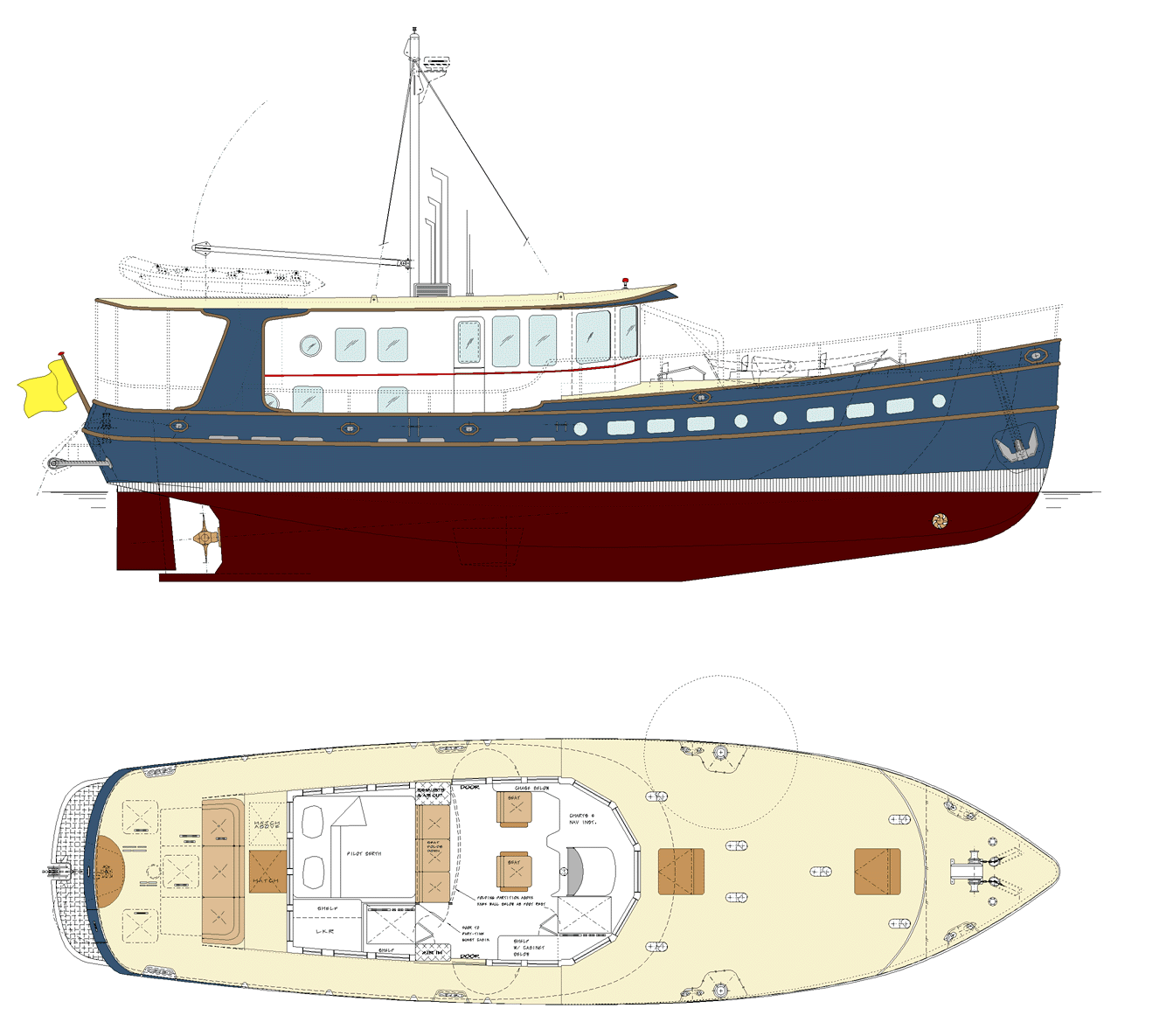
Larger Color Profile & Deck Plan | Interior Profile & Arrangement Plan | Larger Interior P&A
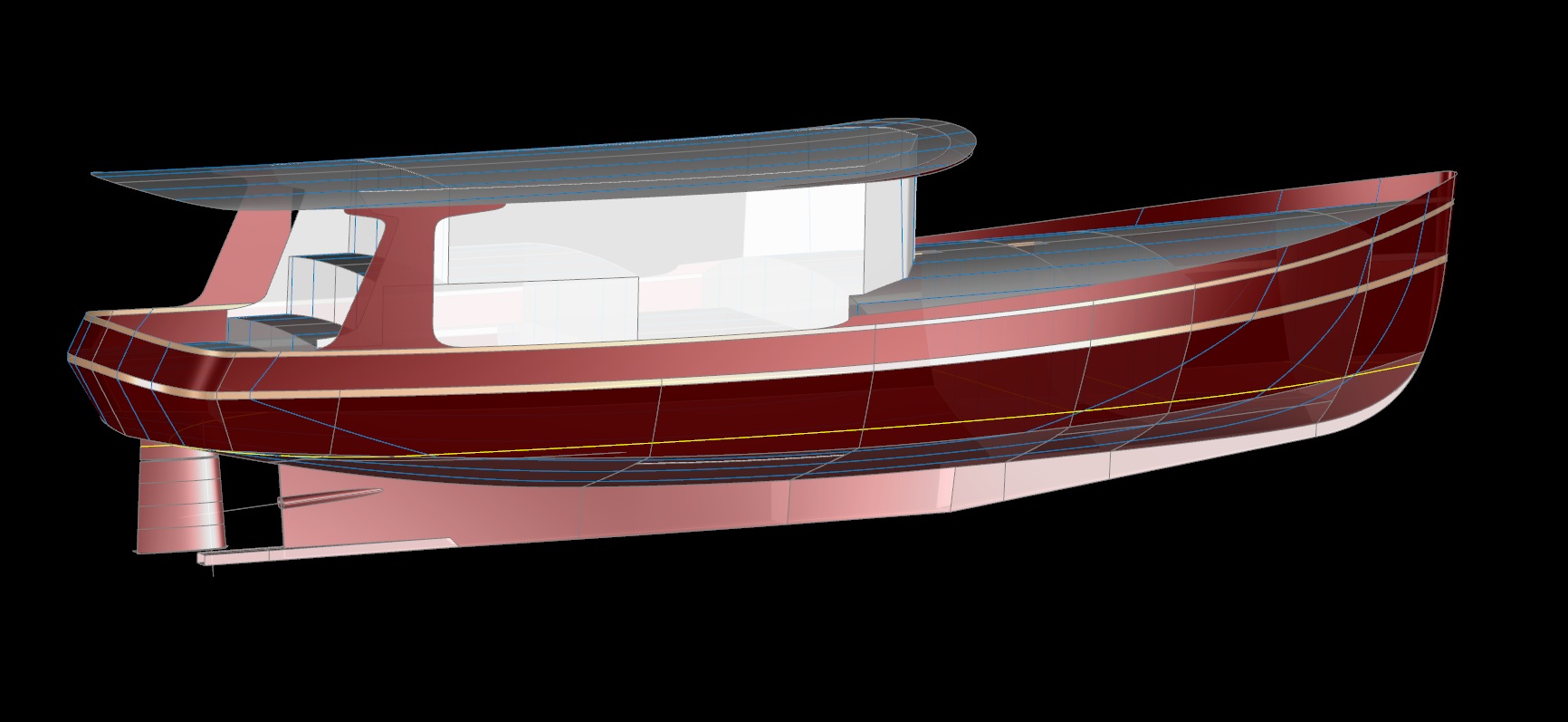
Perspective Starb'd Side | Perspective Starb'd Aft | Perspective Port Forward | Perspective Port Aft | Alternate Port Aft PerspectiveSee Larger 70' Valdemar Below
Copyright 2005 - 2014 Michael Kasten
General Concept
The design name is from the Danish king Valdemar who in the 1200's united the Nordic and Baltic countries into one kingdom - an early-day European Union of sorts...The design request for this vessel was to create a strong, classic, three stateroom displacement trawler for a couple with guests, with the objective of retirement living aboard, long summer cruises, ocean passage making, and travel on the canals of Europe, including the capability for a circumnavigation. The structure is all aluminum, primarily for lightness, ruggedness, ease of maintenance, longevity and lasting value.
Designed to be able to cruise the French Canal system, the dimensions of Valdemar were limited to what the canals can handle. Per the Freycinet standard, the maximum air draft is 3.50 meters (11' - 5.8"), the maximum water draft is 1.80 meters (5' - 10.9"), and the limiting beam is 5.0 meters (16' - 4.9"). Air draft (bridge clearance) is always the most restrictive - therefore the greatest challenge.
For ease of construction, all plating, framing and internal structures have been detailed for NC cutting, including integral water and fuel tank faces, engine girders, etc.
Vessel Particulars
Displacement will vary from approximately 54,500 lb in the light load condition to approximately 67,500 lb in the full load condition. Other particulars are:
- 52' - 9" Moulded Length Overall
- 14' - 6" Moulded Beam
- 49' - 8" WL Length, Half Load
- 5' - 2" salt water Draft, Full Load
- 11' - 5" Air Draft, Half Load
Power & Range
The engine we have specified is a John Deere 6068 TFM 6 cylinder diesel, which produces 175 hp at 2,400 rpm in the M-2 rating. The engine is mated to a Sabb controllable pitch gear using a 3:1 reduction to drive a Helseth three blade 34" CP propeller.
The "cruising speed" for long range voyaging with this hull is assumed to be around 8 knots. Theoretical hull speed is around 9.5 knots, however due to the relatively light displacement, the hull should reach close to 11 knots with the planned horsepower.
Using 5,000 liters (1,321 USG) of fuel and keeping a 15% reserve, the Beebe algorithm shows range in the average load condition to be approximately 3,000 NM at 8 knots.
Click for Larger ImageExterior Arrangement
The aft deck, side decks (and interior pilot house deck) are all at one level. There are two exterior water tight doors entering the pilot house forward. The side and aft decks are surrounded by substantial bulwarks, and the fore deck by a safety toe rail. All decks are surrounded by lifelines with welded aluminum pulpits forward and aft.
Right aft is a full width aft-facing seat, arranged in order to be extended into a spare double berth for the fun of sleeping on deck when the weather permits. A mast and paravane rig are located just aft of amidships with all control lines easily operable from the side decks. The fore deck spans the full width of the boat from bulwark to bulwark. This provides a huge volume within the forward accommodations below. Davits port and starb'd allow placing a shore boat onto the fore deck.
A well-deck is located forward, in order to contain the anchor gear. A dual capstan horizontal anchor windlass is located in the well deck, and will accommodate the two working anchors - arranged in hawse-pipes for easy handling.
The pilot house top extends all the way aft in order to cover the aft deck so it will offer welcome shade in hot sunny climates, and shelter during foul weather. A pair of 'wing plates' flank the forward end of the aft deck so the aft seating area can be enclosed by a pair of rigid or canvas doors and / or screens forward, plus a vinyl - canvas awning around the stern. This extends the usefulness of the aft deck area into cooler seasons. Screens keep the bugs away and the awning / dodger adds privacy for canal cruising.
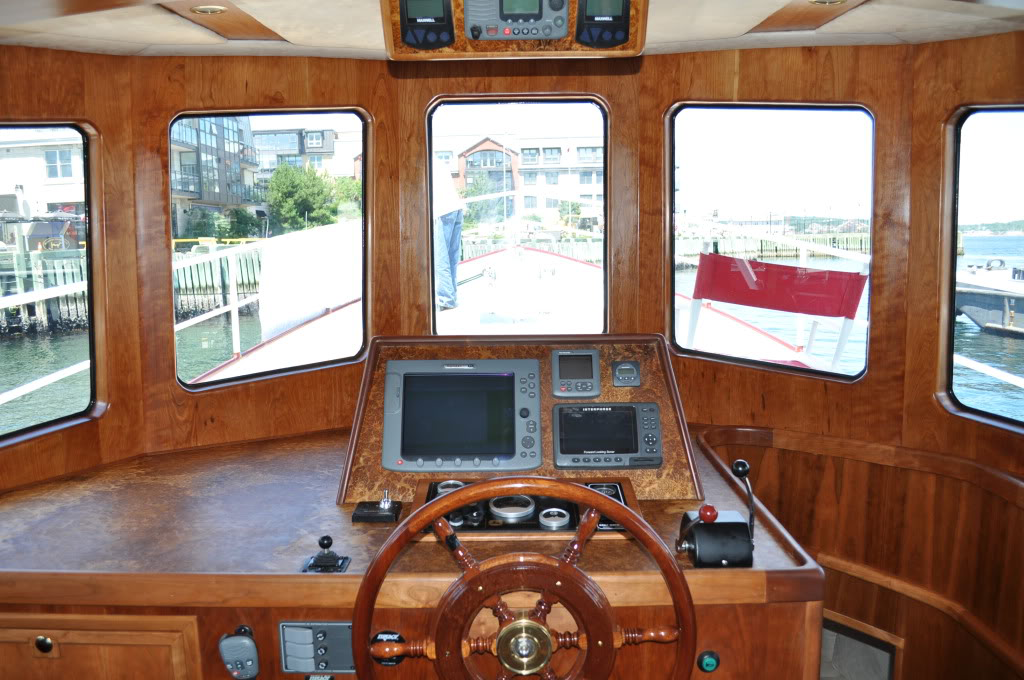
Photos of the Completed Interior:
Pilot House | Galley | Looking Forward | Guest Cabin | Day Head | Master Cabin Aft | Master Cabin Forward
Interior Arrangement
The layout is intended to allow comfortable cruising for up to six adults, and also offers the possibility of chartering the boat if desired. In charter mode, one or two couples can be accommodated on overnight cruises or longer voyages.
Beginning right forward, there is a guest cabin arranged with plenty of shelves and generous hanging locker space. Just aft of the forward guest cabin are a separate pair of head compartments very much as with the Vagabond 50 and the Vagrant 49.
Aft of the head compartments, a large L-shaped galley is located to starb'd at the base of the companionway. The galley contains a refrigerator / freezer aft, big single sink, and a three burner propane range. To port is a large wrap-around dinette and table, sized for six. The intent is that this will be the primary entertainment space. Having a full width raised foredeck, the galley and saloon will be light and open with unobstructed views to port and starb'd.
At the aft end of the saloon / galley on center is a WT door leading into the engine room below the pilot house. Access to the engine room is also via large opening hatches in the pilot house sole. At the aft end of the galley, to starb'd, is a spiral stair leading to the pilot house.
At deck level within the pilot house, WT doors access the exterior side decks to port and starb'd. A helm station is located on center and a large bench seat is located to port, aft. There is a narrow table with a drop leaf, allowing occasional meals to be taken there, or just for observing and conversing with the helms-person.
Aft of the pilot house and below is the owner's cabin, accessed by a companionway ladder to port and aft within the pilot house. The owner's cabin contains a private head and shower, queen size berth, large hanging locker and wrap-around shelves for storage.
Above the owner's cabin is a "pilot berth" located in the aft part of the pilot house. The concept here is to allow an area of the pilot house itself to be enclosed when desired in order to provide privacy for sleepers in this area, allowing it to function as a second part-time "guest cabin." At other times, the whole pilot house will remain open for best visibility all around.
Owner's Commentary...
Regarding the Valemar in rough water, the owner writes...
Yes – we were in probably 10 foot seas and 30 – 40 kt winds and felt no need whatsoever to lower the paravanes. She rode quite well.
On another occasion I had a friend take the boat from Rhode Island to North Carolina. He had been on boats for decades, but, given his age (86) I didn’t feel that he could realistically mess with the paravanes, so I didn’t tell him how to use them. On the passage from Block Island to Norfolk, which he did nonstop and direct, they were in some really rough seas. I am told there was water over the side deck and green water on the front windshield. Still, the boat performed marvelously.
Carlos, a friend who was aboard, summed it up when he told me “Alan, I was a little nervous when we started getting in the big seas, but every time she just came right up and pushed on. I would go anywhere in that boat.”
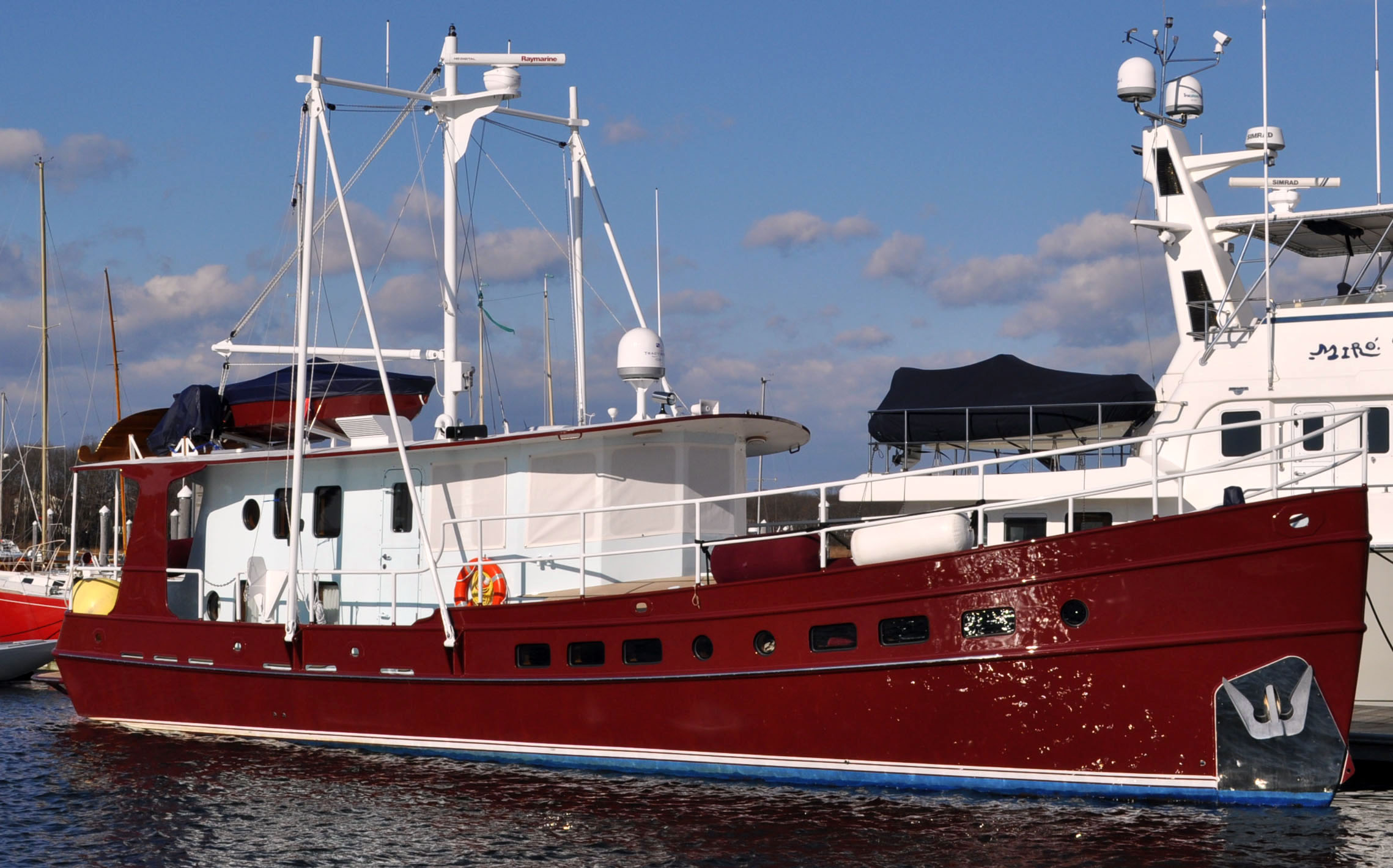
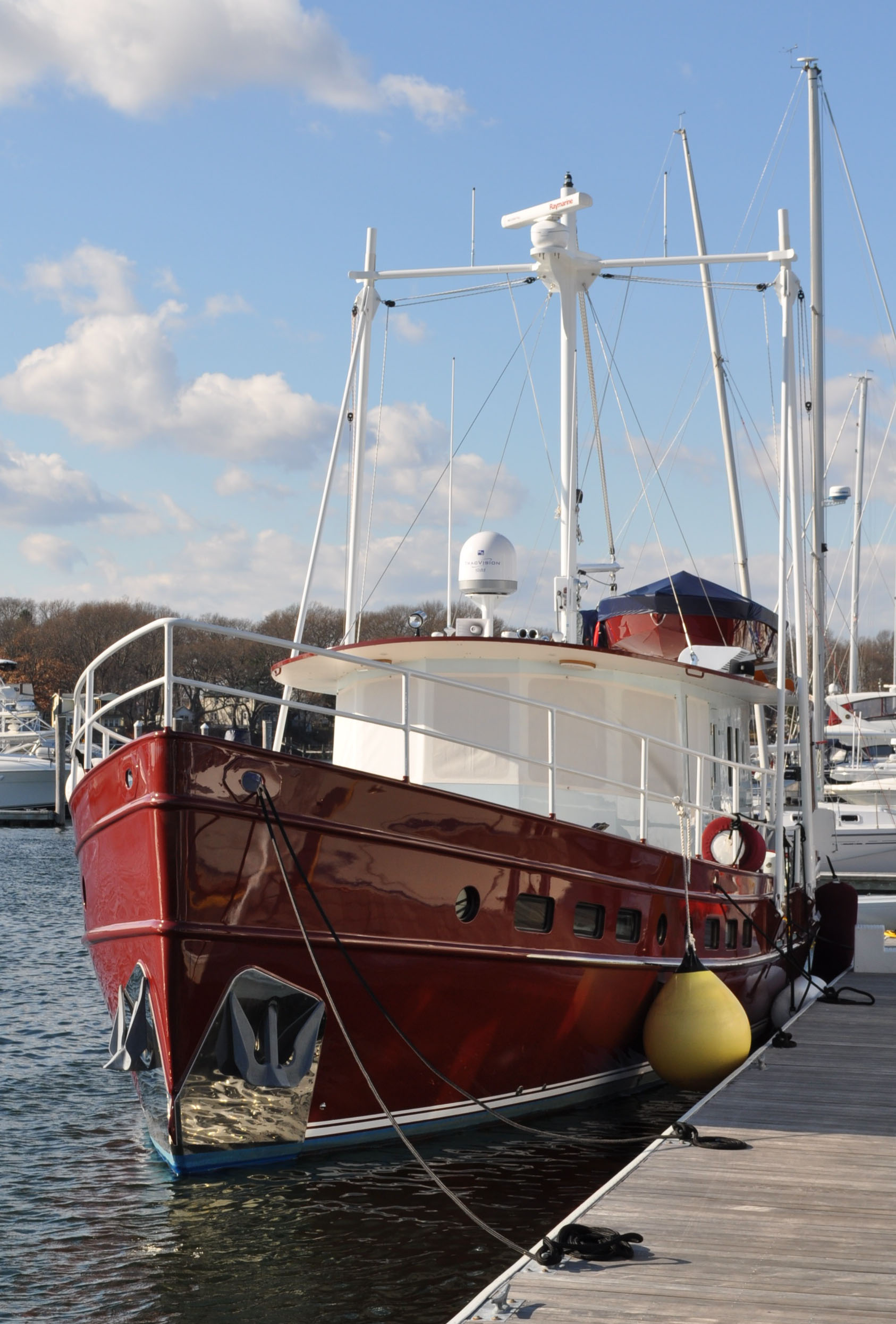
Regardless of the marina, she is always the Belle of the Ball. Debbie and I were in Newport a couple of months ago, docked right next to a beautiful 80 foot or so sailboat on one side and a 70+ foot “go fast” fiberglass thing on the other side. It was a hoot - as always - to watch people walk down the dock and essentially ignore the larger and quite impressive yachts to stop and stare at our boat.
Be good,
Alan Wagner
Click for Larger ImageDesign Genesis
As with our other designs in this series, the Valdemar 53 hull form has been adapted from real trawlers - US West Coast fishing vessels which have to operate in all weathers - including in the Gulf of Alaska, a place where the ocean is... well, not so nice. Our aim has been to retain the excellent sea keeping qualities of those working craft, and to refine their lines into 'yacht' form to achieve a more easily driven hull with relatively light displacement. See the following links for vessels in the Gulliver / Greatheart series...
Greatheart 36 | Vagabond 36 | Gulliver 46 | Greatheart 48 | Greatheart 54
Greatheart 60 | Swallow's Nest 60 | Braveheart 53 | Braveheart 63 | Swallows Nest 70In order to achieve a proportionately longer waterline and more interior space without increasing boat length, we developed another series of designs based on the same hull form, but with a more upright stem and transom. Combined, this reduces the overhangs and increases the WL length to gain more interior space with less overall hull length. Check out the following links for boats in the Vagabond series...
Vagrant 49 | Vagrant 70 | Vagabond 50 | Voyager 52 | Valdemar 53 | Valdemar 70 | 37m Peri Laut
Larger 70' Valdemar - Click for Larger ImageV-70 Side Aft | V-70 Side Fwd | V-70 Above Aft | V-70 Side View
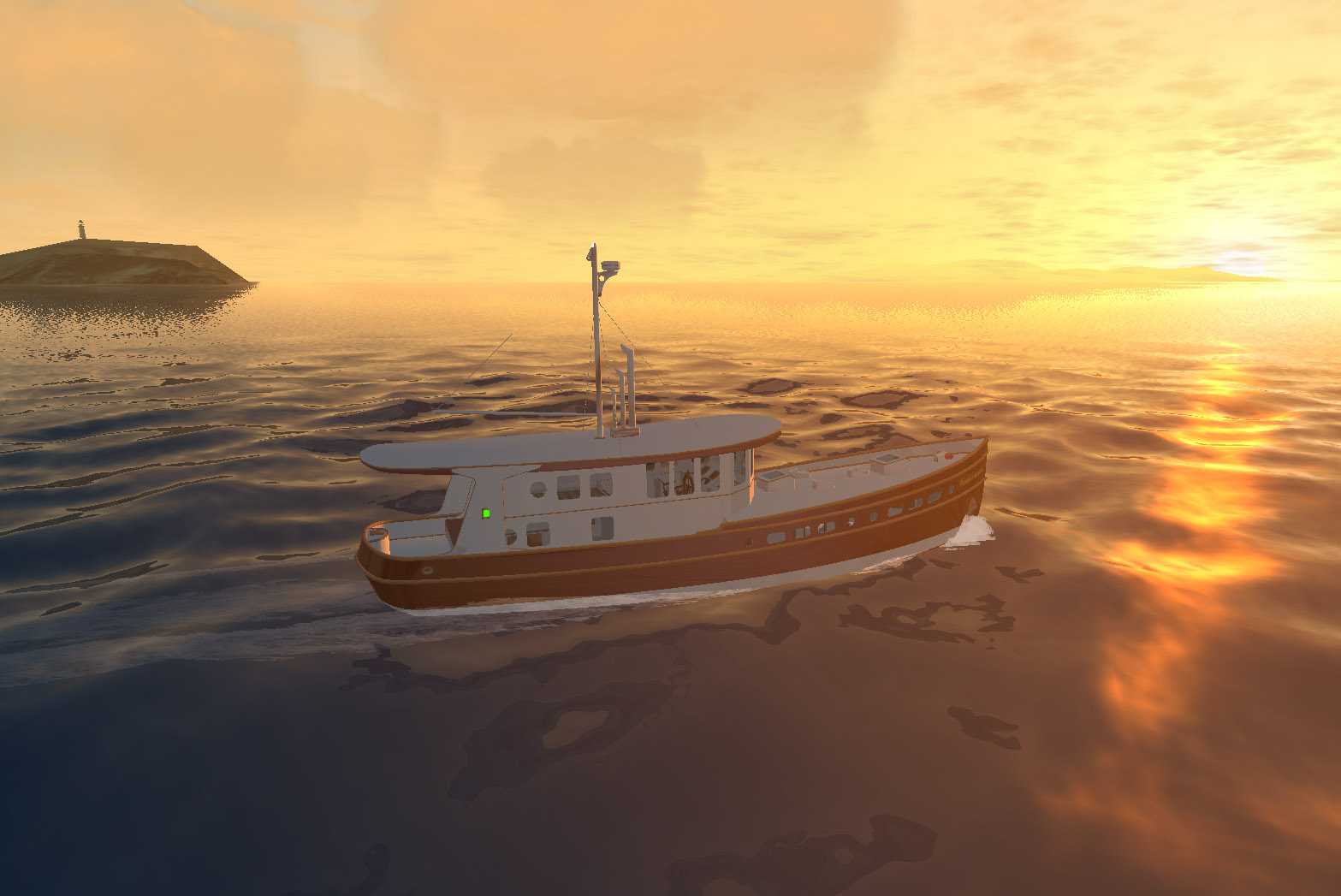
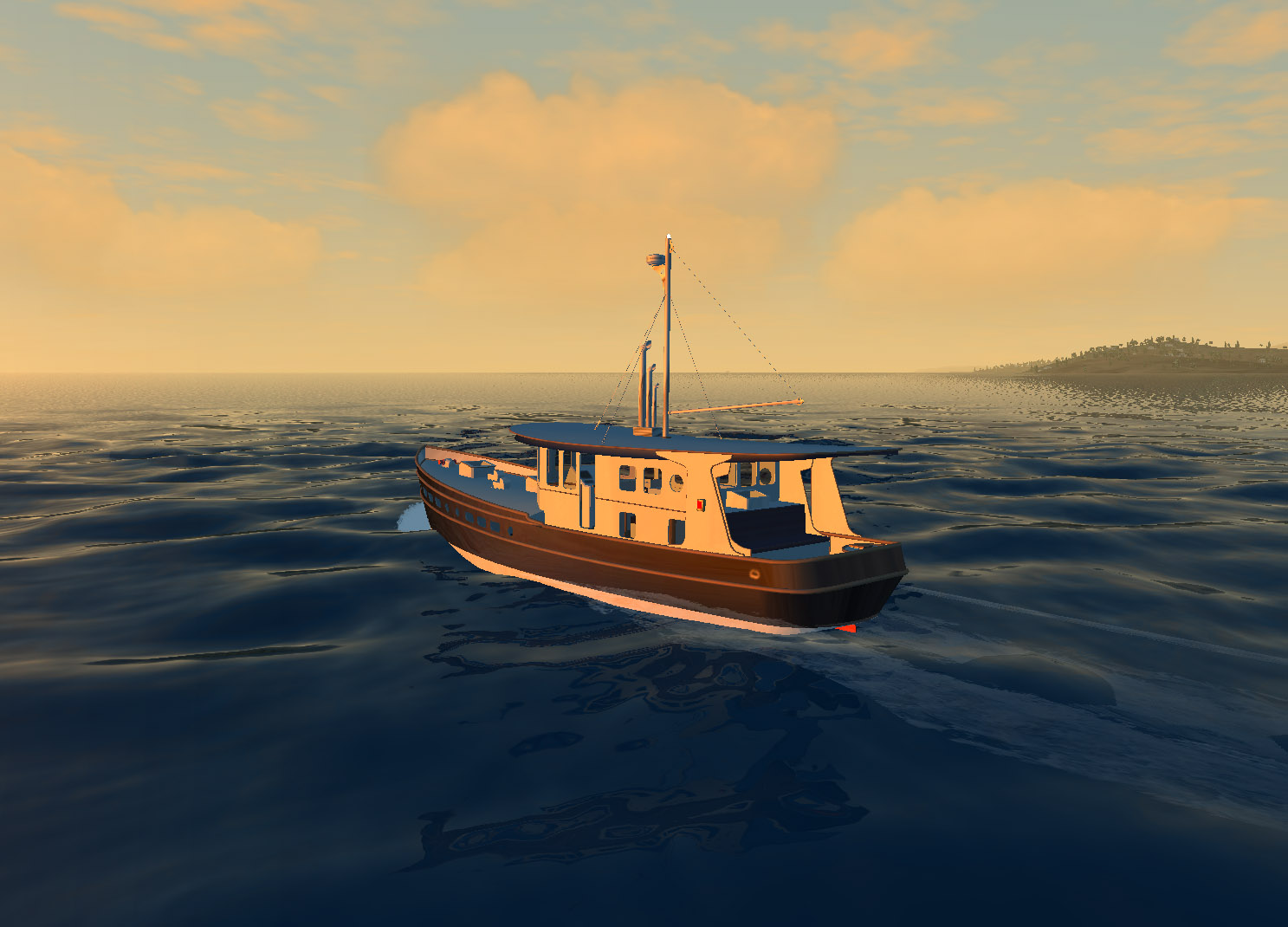
Valdemar in the Aegean - Click Images to Enlarge
Virtual Sailor Model by Alan WinterFor more information on this or other designs, please inquire.
Please see the AVAILABLE BOAT PLANS web page.
Home | Intro | Our Design Process | Stock Design Info | Motor Yacht Designs | Sailing Yacht Designs | Prototype Designs
Plans List | Articles | Our CAD Design Stream | Maxsurf | SITE MAP..! | Site Search | Design Team | Contact Us