Messing about in boats since 1975. Online Since 1997.
Home | Intro | Our Design Process | Stock Design Info | Motor Yacht Designs | Sailing Yacht Designs | Prototype Designs
Plans List | Articles | Our CAD Design Stream | Maxsurf | SITE MAP..! | Site Search | Design Team | Contact Us
Please see the AVAILABLE BOAT PLANS web page
The 60' Aluminum Trawler Yacht
Greatheart
Interior Profile & Arrangement | Deck Plan | Larger Color Sail Plan | Large Sail Plan - Alternate Colors
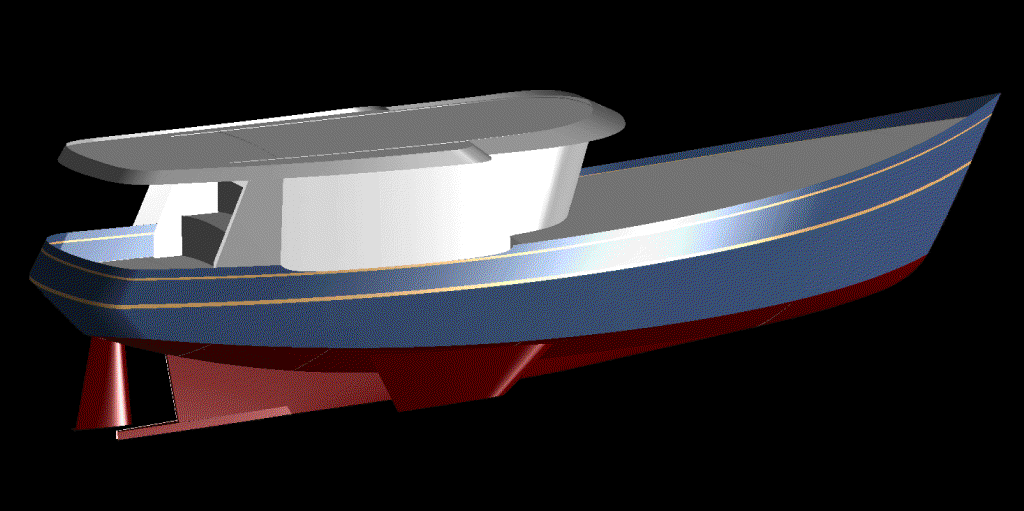
Side Perspective | Aft Perspective | Portside Rendering | Starb'd Rendering
Copyright 2001 - 2014 Michael Kasten
General Concept
The idea behind the Greatheart 60 is to create a true pelagic vessel; one that can spend long periods of time between ports of call. Optimized as a habitat for ocean travel, the 60 foot Greatheart has a hull form similar to others in the Gulliver and Greatheart design series. This family of hulls have been derived from seaworthy Pacific Northwest fishing vessel types, except that the Greatheart / Gulliver series are much more refined for service as yachts, primarily for the sake of efficiency and ease of motion.
Hull construction is all aluminum for the sake of ruggedness and peace of mind, while still having low maintenance requirements. Particulars are:
- Waterline length: 50.4 feet light, 52.5 feet loaded
- Beam: 14.5 feet
- Draft: 5.6 feet
- Displacement 57,000 lb. light, 73,000 lb. loaded.
If built in steel, the beam and hull body depth would necessarily be increased in order to carry the added weight of structure. In steel, beam will be on the order of 16.9 feet, and displacement will vary between 72k lb and 88k lb, depending on equipment choices.
Power
The Greatheart 60 was created to take maximum advantage of the many excellent 6 cylinder diesel engines now available with around 150 horsepower such as the capable John Deere 6086, the Lugger 6 cylinder Turbo, or the Caterpillar 6 cylinder Turbo. Any of these engines are well suited to the power requirements of the GH 60. The JD or Lugger will provide a bit of weight savings over the CAT engines yet will provide nearly the same horsepower.
The gear will be a Sabb HVP 85 E for controllable pitch, or if fixed pitch is preferred a standard Twin Disc gear would be used instead. The Sabb gear is designed to provide both gear reduction and pitch control. The wheel is a 40 inch diameter three blade Controllable Pitch Propeller by Helseth, of Norway. Along with the sail rig, the CP propeller will contribute to maximum efficiency under power, in particular while motor-sailing. One can choose a suitable engine rpm and just feather the propeller to provide just the right boost to boat speed. With a CP propeller, boat speed can be dead slow, or just a bit more to troll for salmon, or quite a bit faster for tuna...
The propeller always turns the same direction, so maneuvers are made simpler because there is no requirement to stop the propeller. One can just feather the blades around to reverse, etc.
The Rig & Keels
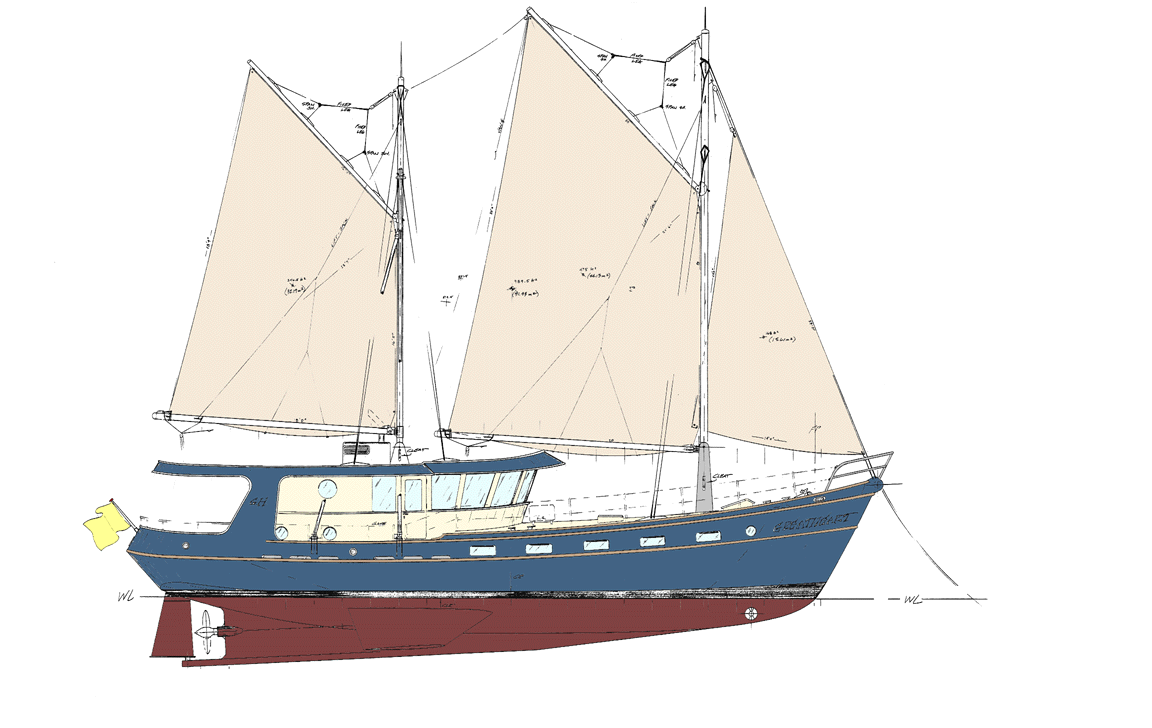
Sails are provided as emergency get-home power, as roll dampening devices, and for the possibility of motor-sailing during passages. Motor sailing provides a synergy that has to be experienced to be appreciated... With this combination, the range of the vessel is vastly increased. When the wind favors there is the very welcome potential to spend long periods without the engine running at all.
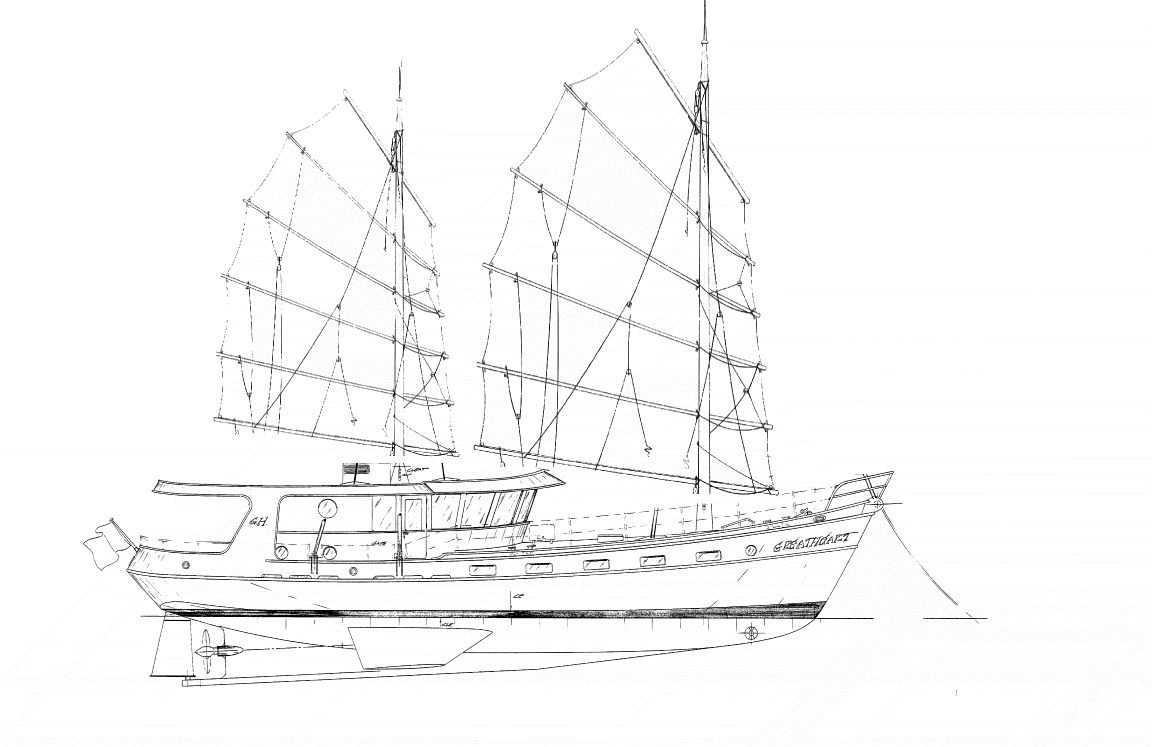
The Greatheart 60 has been shown with a gaff ketch rig, as above, and also a Chinese junk rig as shown below. The Chinese junk rig is an excellent choice with many significant advantages, and at least to my own eye the Junk sails seem to look 'right' for the boat. Please see the web page on the Junk Rig for more information on the various reasons one might favor this rig. Another example of what is possible with the rig can be seen on our Chantage 64 design - a bit more sail area and a gaff schooner rig. Nice...!
With either rig, the spars are all aluminum pipe for lightness, strength, and ease of maintenance. With a graceful taper at the top, to the casual observer the spars are usually taken to be wood.
Twin keels of a conservative size are provided for the sake of sitting upright when aground, to carry a small quantity of ballast, to provide enhanced roll attenuation, and to allow an element of windward performance under get-home sail power.
Cllick for Larger ImageInterior
Aft is the owner's stateroom, with an island berth on center, a pull-out mini desk on each side of the berth, a private head / shower, hanging locker, and entertainment center.
Stepping up into the Pilot House, we find a double seat to port facing forward. A table and fold-up leaf is just forward of the double seat. A large pilot berth is located right aft, above the aft cabin. A navigator's station is forward to port, and a helm is located on center with full instrumentation. This layout is intentionally fairly open and un-crowded.
If we go forward, a winding staircase leads below to a large galley and wrap-around dinette table. This is the primary social area so the seating has been made quite large. With sleeping for eight (including the 'small double' in the pilot house) there does need to be plenty of seating!
Just forward of the galley (to starb'd) is a head compartment with a bath tub / shower and is equipped with a flip-down teak slat seat. Opposite the head is a 'bunk room' intended for children or crew. It contains a night stand, two single berths, a hanging locker and small bureau / entertainment center.
The forward stateroom is for honored guests and features an island berth right forward, accessible from both sides. There is ample storage within two hanging lockers and a very large storage area below the berth.
Summary
Whether the sailing rig were to be as a gaff ketch or gaff schooner or Chinese junk the Greatheart 60 profile is already rather 'sail boat like' in terms of the keel and rig, yet quite 'power boat like' in terms of the pilot house. Altogether a fine ocean traveling habitat for an extended family or for specialty adventure charters.
Design Genesis
As with our other designs in this series, the hull form for the Greatheart has been adapted from real trawlers - US West Coast fishing vessels which have to operate in all weathers - including in the Gulf of Alaska, a place where the ocean is... well, not so nice. Our aim has been to retain the excellent sea keeping qualities of those working craft, and to refine their lines into 'yacht' form to achieve a more easily driven hull with relatively light displacement. See the following links for vessels in the Gulliver / Greatheart series...
Greatheart 36 | Vagabond 36 | Gulliver 46 | Greatheart 48 | Greatheart 54
Greatheart 60 | Swallow's Nest 60 | Swallowtail 60 | Braveheart 53 | Braveheart 63 | Swallows Nest 70In order to achieve a proportionately longer waterline and more interior space without increasing boat length, we developed another series of designs based on the same hull form, but with a more upright stem and transom. Combined, this reduces the overhangs and increases the WL length to gain more interior space with less overall hull length. Check out the following links for boats in the Vagabond series...
Vagrant 49 | Vagrant 70 | Vagabond 50 | Voyager 52 | Valdemar 53 | Valdemar 70
For more information on this or other designs, please inquire
Click for Larger Image
Please see the AVAILABLE BOAT PLANS web page.
Home | Intro | Our Design Process | Stock Design Info | Motor Yacht Designs | Sailing Yacht Designs | Prototype Designs
Plans List | Articles | Our CAD Design Stream | Maxsurf | SITE MAP..! | Site Search | Design Team | Contact Us